


An atheist says, “There’s no evidence for God. I can’t find God anywhere or measure God’s presence.”
In response, I might say something like this:
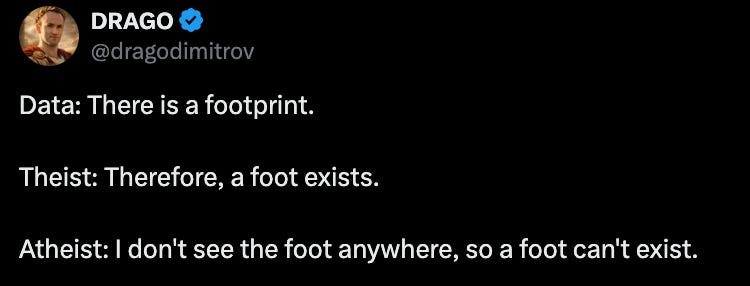
You can infer the existence of a cause through the observation of its effects. If I see a footprint, I don’t need to see an actual foot to know that the foot exists.
This is a nice move to get the conversation going, but the astute atheist can see right through it.
When I say “footprint”, it activates a pre-existing concept in your mind that comes with a cause-effect story that’s already baked into the word.
Your own eyes have seen the full chain—you have experienced the full story—of a foot impressing itself into the ground and leaving a footprint countless times, whether it’s from the crinkling of the snow underneath your steps, a child running through the sandy beach, or an animal leaving tracks in the forest.
To analogously label reality as a “footprint” is to beg the question, as doing so frames the observed data as requiring a cause (in this case an intentional one). If, instead, we were to call what we see, “a different arrangement of dirt” (rather than a “footprint”), such a less-committed characterization of the phenomenon would strip away the pre-baked assumptions of intentionality and its appeal to sampled pattern recognition.
In other words, whether reality truly represents a “footprint” (a known effect with a cause) versus a mindless arrangement is precisely the issue in contention between the atheist and theist.
Before I explain the more important theistic move, let us further drill in the strength of the atheist’s objection.
The reason why you and I know with high confidence that a foot leaves a footprint (or that a footprint was caused by a foot, if you prefer) is because we have witnessed a substantial sample size of feet causing footprints. I have experienced the phenomenon of “footprint” in many instances, each of which serve to justify the reasonableness of me making a causal inference that a foot made the print.
But when it comes to the sample size of the universe… we only have one universe. n = 1.
We haven’t experienced other universes, let alone the beginning of this one.
You cannot make a valid empirical inference from only one observation.
What the theist would need here (according to the atheist), is a sample of multiple universes to compare to, such that you could look at a designed universe vs the undesigned universe and then be able to spot the difference. In fact, through traditional empirical analysis, this would be the only way to know that our universe was “special” compared to some baseline comparison.
And yet, we don’t have any other universe to compare our own universe to.
We don’t have one universe labeled “designed” and another labeled “undesigned.” We can’t line them up in a lab and say, “Ah, yes, ours resembles category B.”
At this point, we should be clear: I am no longer defending a simplistic version of intelligent design as a mere analogy from artifacts. I am moving to the older and deeper claim of classical theism: that this one reality already displays intelligible structure — order, causality, mathematics, rational knowability, and dependent being — and that we can ask whether that whole structured order explains itself.
So does the n = 1 objection defeat the theistic argument?
It depends which argument we mean.
If the argument is, “This universe looks like other designed universes,” then yes, the objection has force.
But classical theism is not mainly making that argument.
Here’s the part people miss: the classical theist is not asking a horizontal question.
He is not asking, “What other universe does this universe resemble?”
He is asking a vertical question: “What must be true for this kind of reality to exist at all?”
That is a totally different kind of question.
Science studies the patterns inside reality.
Metaphysics asks why there is a reality with patterns in the first place.
To understand the difference, we need to distinguish between horizontal reasoning and vertical reasoning.
Horizontal vs Vertical Reasoning

Horizontal reasoning compares members of a class.
Vertical reasoning asks what grounds the class, the system, or the whole order of reality itself.
Let’s get more specific.
Horizontal reasoning moves sideways. It compares one member of a class to other members of that same class.
This tree compared to other trees.
This animal compared to other animals.
This disease compared to other diseases.
This planet compared to other planets.
This footprint compared to other footprints.
Horizontal reasoning asks:
What is this thing like?
It wants a sample set. It wants repeated cases. It wants to classify one thing by comparing it to other things of the same kind.
And this kind of reasoning is incredibly powerful. It gives us medicine, engineering, biology, forensics, and the ordinary pattern-recognition we use every day.
But when we ask about reality as a whole, horizontal reasoning eventually reaches its limit.
Because the universe is not one object sitting next to other objects.
It is the whole field in which objects, causes, laws, measurements, minds, and explanations appear.
So when the atheist says, “You only have one universe,” he is right if the theist is trying to compare this universe to other universes.
But that is not the classical theistic move.
The classical theist is not saying:
This universe resembles other designed universes I have seen.
He is saying:
This universe contains dependent, ordered, intelligible reality. What must be true for such a reality to exist at all?
That is vertical reasoning.
Vertical reasoning does not ask:
What other thing does this resemble?
It asks: “What is this resting on?”
Or: “What makes this possible?”
Horizontal reasoning compares members of a class.
Vertical reasoning asks about the ground of the class itself.
Science can tell us how one event inside the universe relates to another event inside the universe. It can tell us how stars form, how cells divide, how gravity behaves, how light bends, how particles interact, how organisms evolve.
But metaphysics asks a deeper question:
Why is there an ordered, intelligible, law-governed reality in which science can operate at all?
This is not anti-science. It is beneath science.
Science presupposes that reality is intelligible.
It presupposes that nature has stable patterns.
It presupposes that mathematics maps onto matter.
It presupposes that causes can be investigated.
It presupposes that the human mind can discover truths about the world.
Metaphysics simply turns around and asks: Why are those presuppositions true?
That is why the n = 1 objection is not the knockdown argument it first appears to be.
It defeats a crude comparison argument.
It does not defeat vertical explanation.
The question is not:
Have you seen another universe?
The question is:
Does this universe explain itself?
And once we ask that question, we are no longer talking about a footprint in the dirt. We are talking about the existence of dirt, feet, minds, causes, order, mathematics, and the very intelligibility by which any of them can be known.
Once you’ve established this reframe, you begin to notice that the debate has moved.
The atheist is no longer merely saying, “You do not have enough samples.” He is now defending a different claim: that the totality of dependent, intelligible, law-governed reality needs no deeper explanation.
That may be his position. But it is not a scientific discovery.
It is a metaphysical stance.
And that is the point.
The modern mind often thinks it has escaped metaphysics because it has become scientific. But that is not true. The moment someone says, “Only measurable things count as real,” he has made a philosophical claim, not a scientific one.
You cannot measure the claim that only measurable things are real.
You cannot put logic in a test tube.
You cannot weigh truth on a scale.
You cannot photograph the number seven.
You cannot detect moral obligation with a microscope.
You cannot run a lab experiment proving that only lab experiments give knowledge.
The world of measurement already depends on things that are not themselves measured in the same way.
So when the theist asks a vertical question, he is not abandoning reason. He is asking reason to examine its own foundations.
He is asking:
Why is there something rather than nothing?
Why is reality intelligible rather than sheer chaos?
Why does the mind fit the world?
Why do mathematical truths describe physical things?
Why do contingent things exist at all?
Why is there a world in which science can work?
These are not questions about one object inside the universe.
They are questions about the whole order of reality.
That is why the “one universe” objection only goes so far.
It says:
You cannot compare this universe to another universe.
Correct.
But the classical theist replies:
I am not trying to. I am asking what must ground this universe, given the kind of universe it is.
The universe is not merely a brute pile of stuff.
It is readable.
Things have natures.
Events have causes.
Patterns can be discovered.
Mathematics unlocks physical reality.
Minds can know truths beyond themselves.
And every finite thing we encounter seems to possess existence in a borrowed, dependent, limited way.
A tree exists, but it does not explain its own existence.
A planet exists, but it does not explain its own existence.
A human being exists, but he does not explain his own existence.
The universe contains being, but the question remains whether it is Being itself or whether it too depends on a deeper source.
This is where classical theism makes its move.
Away from the simpler, “This looks designed in the way a watch looks designed” argument and towards a more refined one: “This reality is dependent, ordered, intelligible, and rationally knowable. What kind of ultimate ground could make that possible?”
That ground is what classical theists call God.
Not one more object inside the universe.
Not a very powerful creature hiding somewhere in space.
Not a measurable item alongside planets, stars, and particles.
But the source of being itself.
The reason there is a measurable universe at all.
So yes, the atheist is right to challenge lazy footprint analogies. If the theist relies only on horizontal comparison, the objection has force.
But the deeper argument does not stand or fall on comparing this universe to other universes.
It stands or falls on whether dependent, intelligible, ordered reality can finally explain itself.
That is the real issue.
Not: “Where is God inside the universe?”
But: “Why is there a universe in which anything can be found, measured, known, or explained at all?”
This one universe is already intelligible, ordered, mathematical, rationally knowable, and filled with dependent beings. We do not need another universe to notice that.
The atheist may reject the classical theist’s answer. But he has not escaped the question