

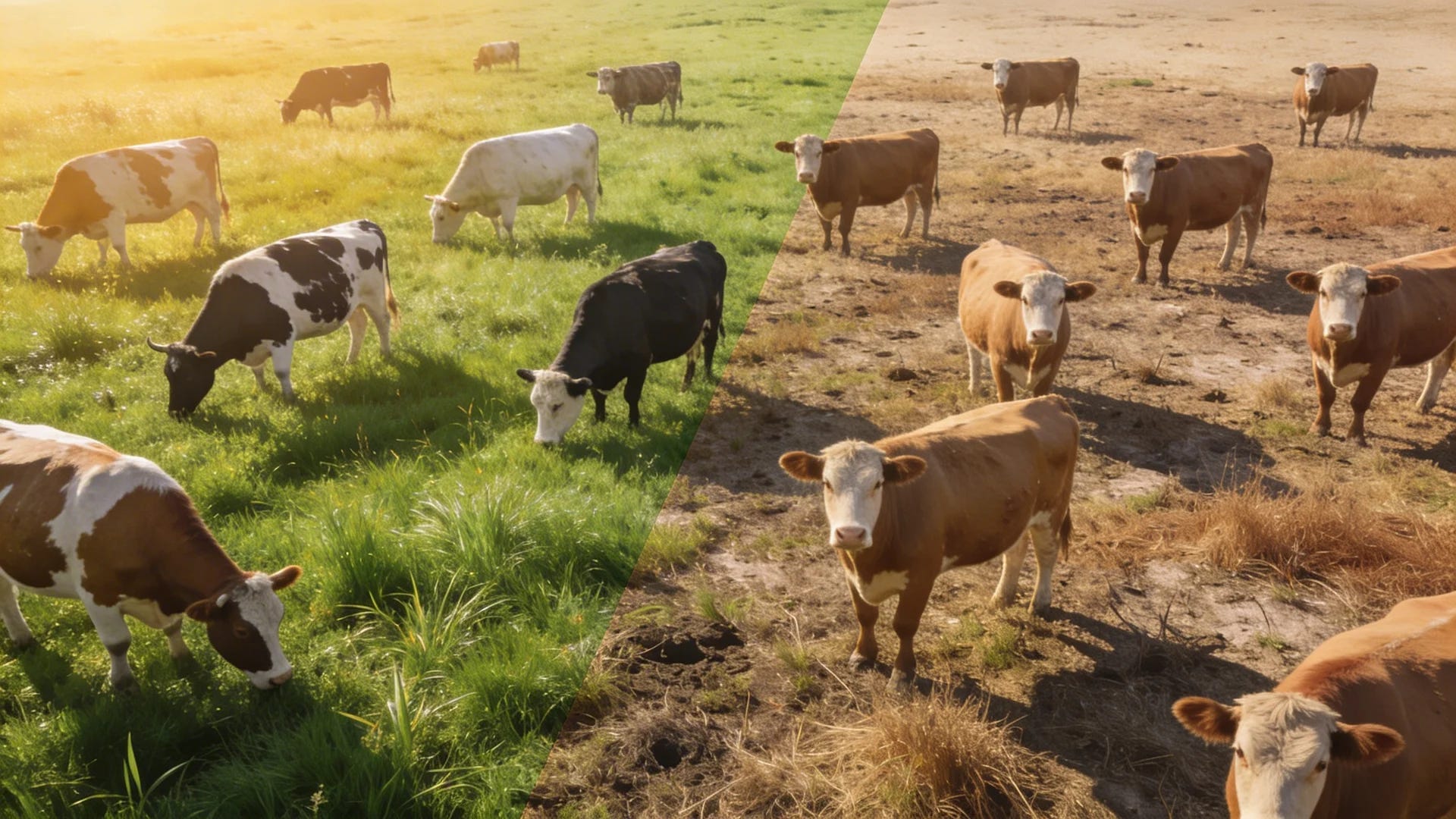
There’s a village where the farmers share access to the same plot of green pasture.
Each farmer has one of his cows grazing on it. It’s a stable and fair setup where everyone benefits.
One day, a farmer sees that there is enough room for him to add one more cow to graze on that grass, thereby increasing his individual output.
Other farmers get the same idea and bring in extra cows as well…
Then, from all this new excess grazing, the common land soon gets exhausted and stops producing grass, which causes a crisis.
If only the farmers were content with the original setup!
This is the tragedy of the commons, or as Aristotle put it:
That which is common to the greatest number has the least care bestowed upon it. Every one thinks chiefly of his own, hardly at all of the common interest; and only when he is himself concerned as an individual.
Now we come to a new scenario.
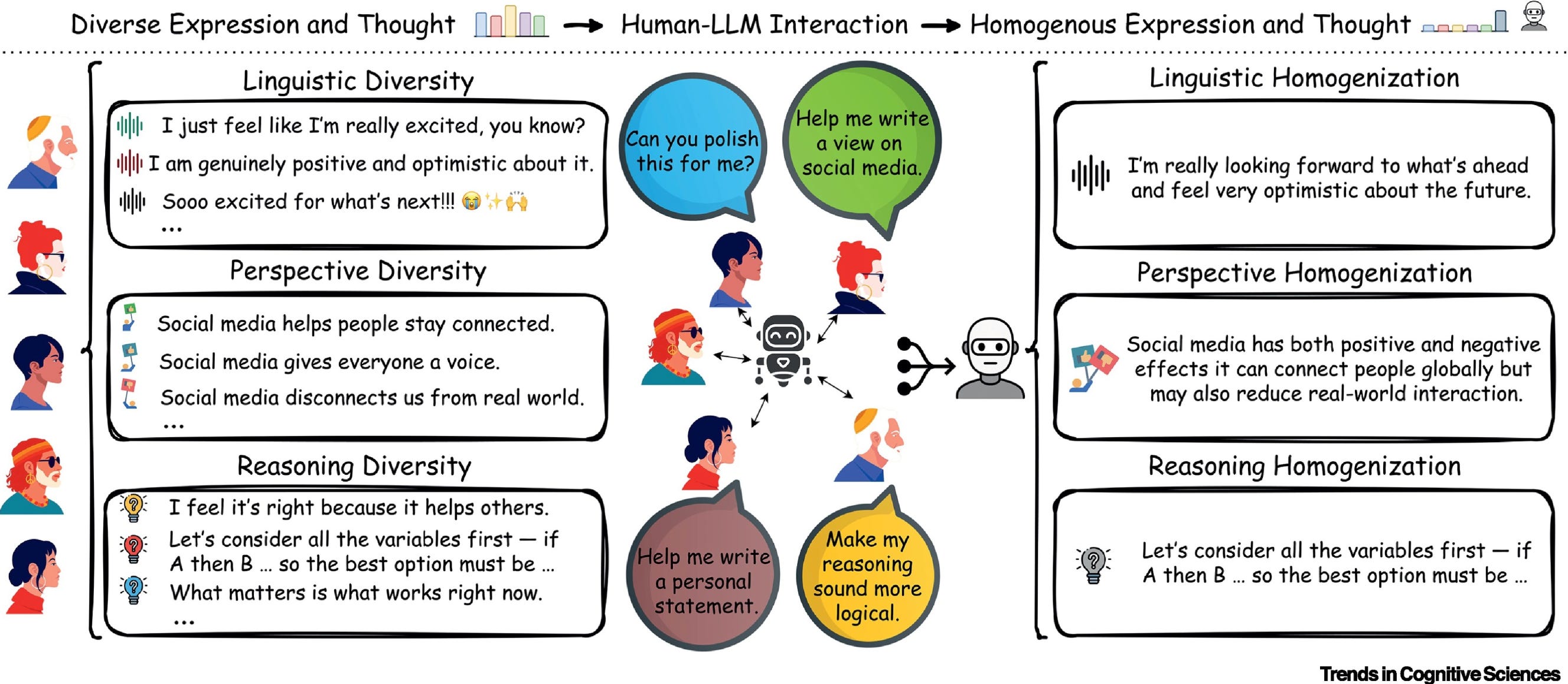
According to a new study (as well as your own personal experience, I’m sure), we have been letting AI homogenize both our expression and thought.
In raw human experience, we encounter a beautiful diversity in how we communicate the same underlying concept. For example, three people might express the same enthusiasm with different linguistic styles:
A) “I just feel like I’m really excited, you know?”
B) “I am genuinely positive and optimistic about it.”
C) “Sooo excited for what’s next!!!”
But if each of these three people uses AI to process their idea instead, they will all get a normalized output like:
I’m really looking forward to what’s ahead and feel very optimistic about the future.
Take a look at this diagram for more such examples:
Like the farmers in the village who want to pursue an individual benefit at the cost of an eventual degradation for everyone, we are now faced with a new Game Theory situation (of which I am guilty of):
You can choose to use AI to write something, and reap the “instant” benefit of time savings and clarity. For example, I can take a half-baked concept that we might rate a 5/10 and AI can immediately pump out a safe 8/10 version of it. We might not get the 10/10, and we might lose some of my individual style, but for the purpose of what it’s for (let’s say it’s marketing copy, a legal document, business correspondence, or something where the primary purpose of the communication is transactional as opposed to artistic), I get the desired outcome much more quickly.
But, as I implicitly allude to in the prior sentence’s parenthetical, we start to lose some of that “artistry” (read: authenticity, individuality) that permeates all of humanity, even in seemingly “non-artistic” contexts like corporate communication.
The truth is that, through a proper lens, everything you do as a human can be understood as being an art. But now we are tempted to dispose of the art in order to reap the benefits of more efficiency and material gain.
So the more we each use AI to replace aspects of our thinking (because that’s what’s really happening here), the more we erode our linguistic diversity and homogenize our thought.
We’re bringing more of our cows to graze on the community pasture until the pasture is no more.
That’s clearly a problem, but I’m not sure what the solution is.
I have no plans at the moment to go cold turkey on AI, but I am seeking ways to find the proper balance.
For one, if you’re a regular reader of my Substack, you know that I make a clear distinction between what is 100% my voice versus what is AI-assisted. In case you can’t tell or don’t feel it right now, you’re currently reading 100% fully certified USDA Prime Drago thoughts.
I put the AI-assisted stuff in my Drago's Assistant section.
So I throw it back to you… What are YOU doing to maintain your humanity in the age of AI? Shall we be doing some AI fasts? Establish certain hard lines we never cross?
Whatever you do, just please promise me you won’t put a chip in your brain.